Astra's Database
Welcome aboard Captain.
This is Astra reporting for duty.
How can I help you today?
Orunethi Physiology
Orunethi PhysiologyName Origin :
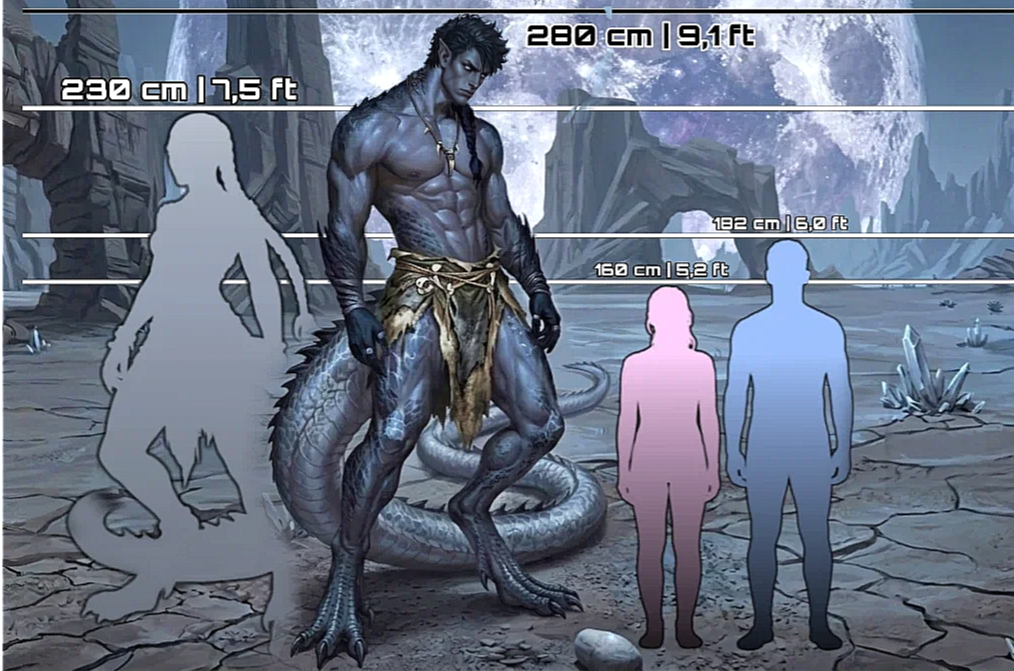
• “Orunethi” roughly translates as “those who listen to the Moon’s breath”— referring to their acute sensitivity to atmospheric pressure shifts, tidal pulls, & magnetic disturbances caused by the gas giant.General Build• Average adult height: Males 260–300 cm; females 190–230 cm.• Body plan is compact and dense rather than elongated, optimized for high-gravity endurance & sudden tidal stress. Muscles are thick and layered close to the bone, giving a powerful but not overly bulky silhouette that still allows agile vertical movement.Dimorphism :
• Males are significantly larger & more muscular, evolved as nest guardians. Their role is to stand watch on exposed ledges, repel predators, and physically block threats. Females are smaller, leaner, & built for superior endurance & stealth. They can squeeze into narrow crevices & fissures to nest & protect eggs/young, conserving energy during long brooding periods while males handle defense and heavy labor (hauling large prey or clearing rockfalls).Skin & Scales• Base skin: Dark charcoal/blue-gray with a cool, leathery sheen that reduces glare under the perpetual twilight and helps retain moisture in thin high-altitude air.• Scales: Large, flexible patches resembling cracked stone or dried riverbed. They cover shoulders, upper arms, sides of torso, back, and outer thighs. These are not rigid armor but living tissue that can slightly flare or tighten. The scales shed sometimes they feel like rocks
- Functions:
- Pressure sensing— micro-changes in scale tension detect shifts in atmospheric pressure before storms or tidal surges hit.
- Thermoregulation & moisture— scales help shed excess heat during rare magnetic storms and trap thin films of moisture from “stone-after-rain” condensation common in their zone.
- Minor protection against scrapes during climbs and bites from smaller cliff fauna.
- Smooth obsidian-like skin on chest, face, and inner limbs allows greater flexibility for breathing and fine movement.Tail
• Length : Approximately 3 meters on adult males (slightly shorter on females). Prehensile and powerfully muscled with flexible scales along its length.
- Functions:
- Primary counterbalance during leaps between spires or vertical climbs on sheer cliffs.
- Sensory organ— tip is highly sensitive to vibrations and air-pressure gradients, acting like a natural barometer and seismograph.
- Weapon and tool— can coil around prey, anchor the body during strong winds, or gently wrap around a mate/offspring for comfort/protection.
- In social signaling, slow tail flicks or rigid coiling convey mood (alertness, calm, warning) without needing words.Legs & Locomotion• Digitigrade stance with thick, pillar-like thighs and strong, clawed feet. This lowers the center of gravity and provides explosive power for jumping across gaps or absorbing impacts from rockfalls/tidal tremors. Excellent for vertical traversal: they can “run” up near-vertical surfaces for short bursts using claws and tail anchoring.Eyes• Fully white with no visible pupils, highly reflective under dim twilight.
- Adaptations:
- Exceptional low-light and night vision— they see clearly in the perpetual gloom of the terminator zone and during heavy magnetic storms that dim the sky further.
- Tapetum lucidum-like layer behind the retina creates the reflective “glow” and boosts sensitivity.
- Likely detect subtle shifts in magnetic fields or polarized light caused by the gas giant, helping predict environmental changes.
- Prolonged direct eye contact feels unnerving to outsiders because the lack of pupils makes their gaze feel piercing and unchanging.Hands & Claws• Large, powerful hands with thick fingers and long, black, talon-like claws (non-retractable).
- Claws are used for climbing, gripping prey, and intricate tasks like weaving fiber ropes or carving soft stone with bone tools. Heavy rings (carved from dense local minerals or polished predator bones) are culturally significant status markers, often earned through proven survival feats.Other Traits• Scent: Cool mineral like wet stone after rain, with a faint metallic edge from trace atmospheric compounds they process.• Hair: Thick, black, worn in a single long braid that reaches around chest (males & females, longer on females reaching waists). The braid helps keep hair out of the face during climbs.Metabolism :
• Highly efficient energy conservation— they can remain still and alert for long periods, burning minimal calories until sudden bursts of activity are needed (fighting, climbing, hunting).Diet :
• Omnivore + insectivore, eats anything available. Able to eat food raw (they usually eat food raw)Reproduction :
• Tied loosely to tidal cycles. Females nest in deep, protected crevices naturally; males guard the entrance. Clutch size small (1–2 offspring) due to harsh conditions. Young are born relatively developed and learn vertical movement quickly.
Veyra Moon
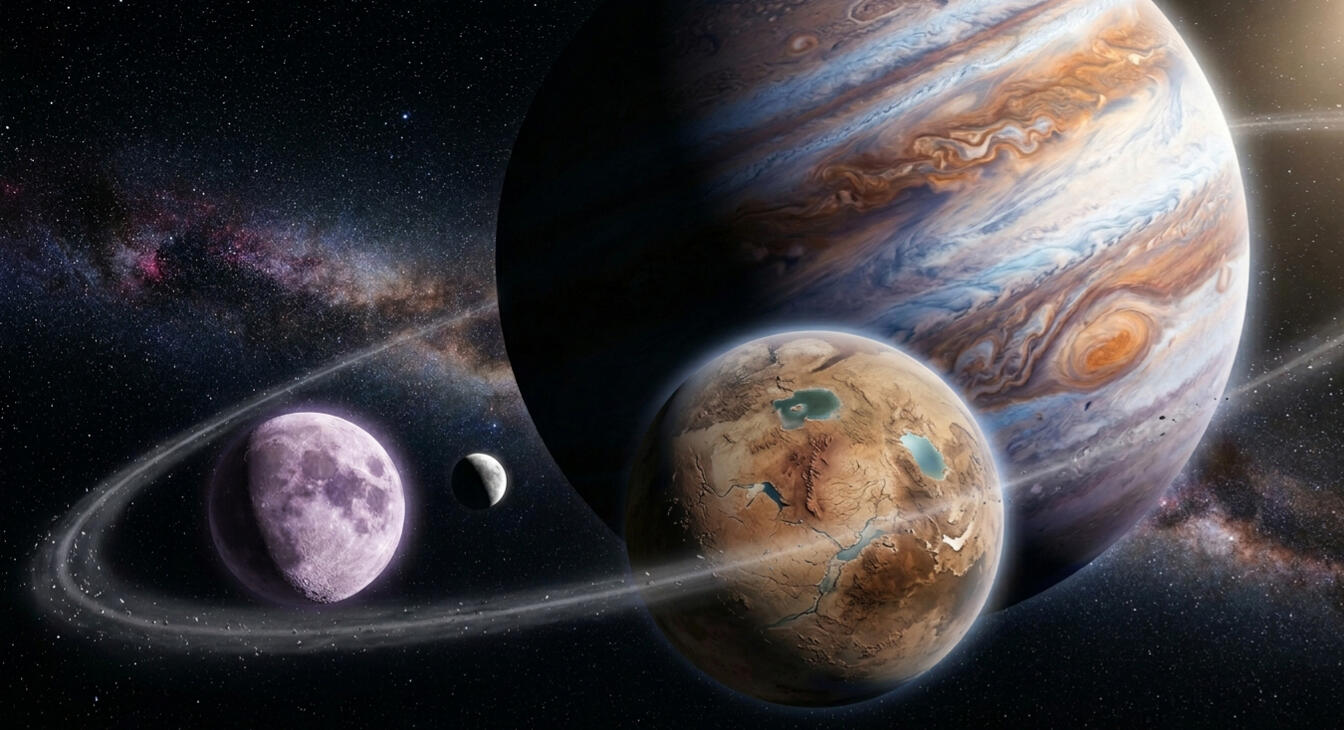
Planet Veyra (the World Beneath the Twin Moons)OverviewVeyra is a large, rugged moon tidally locked to its primary— the massive gas giant Kael’Veyr (the Great Presser). One side of Veyra permanently faces the gas giant, creating a vast twilight zone where most life, including the Orunethi, thrives. The gas giant dominates the sky like a banded, ever-present storm of swirling colors, its gravity causing violent tidal stresses, ground tremors, & high-pressure atmospheric shifts.Veyra has two natural satellites (moons) of its own:• Orun’Thal — The Greater Moon (larger, brighter, with visible cratered face and faint purple-tinged glow). It is the dominant force in Orunethi culture, interpreted as the embodiment of the Moon’s Will. Its slow orbit controls tidal cycles, pressure patterns, and safe nesting windows.
From the surface it appears dramatically large— often dominating a significant portion of the twilight sky with its cratered, faintly purple-tinged face clearly visible to the naked eye. Its slower, more imposing arc controls the primary tidal cycles, pressure shifts, and stable nesting windows. The Orunethi see it as the steady embodiment of the Moon’s Will.• Syl’Kael — The Lesser Moon (smaller, faster-moving, often appearing as a sharp silver crescent or distant spark). It moves quicker across the sky & is seen as a restless “whisperer” that warns of sudden storms or magnetic flares. When the two moons align with Kael’Veyr, the Orunethi call it the Convergence— a time of heightened danger & potential omens.
Smaller & orbiting farther from Veyra. It appears as a sharp, bright silver or distant gleaming orb— noticeably smaller & quicker-moving across the sky. Though clearly visible with the naked eye, it never fills the horizon like its sibling.Astra's Notes :
The perpetual twilight zone (the terminator band) offers the only stable habitable region. The side facing Kael’Veyr is bathed in dim reflected light and occasional eclipses; the far side is locked in eternal cold darkness and largely uninhabited.
Landscape & Environment
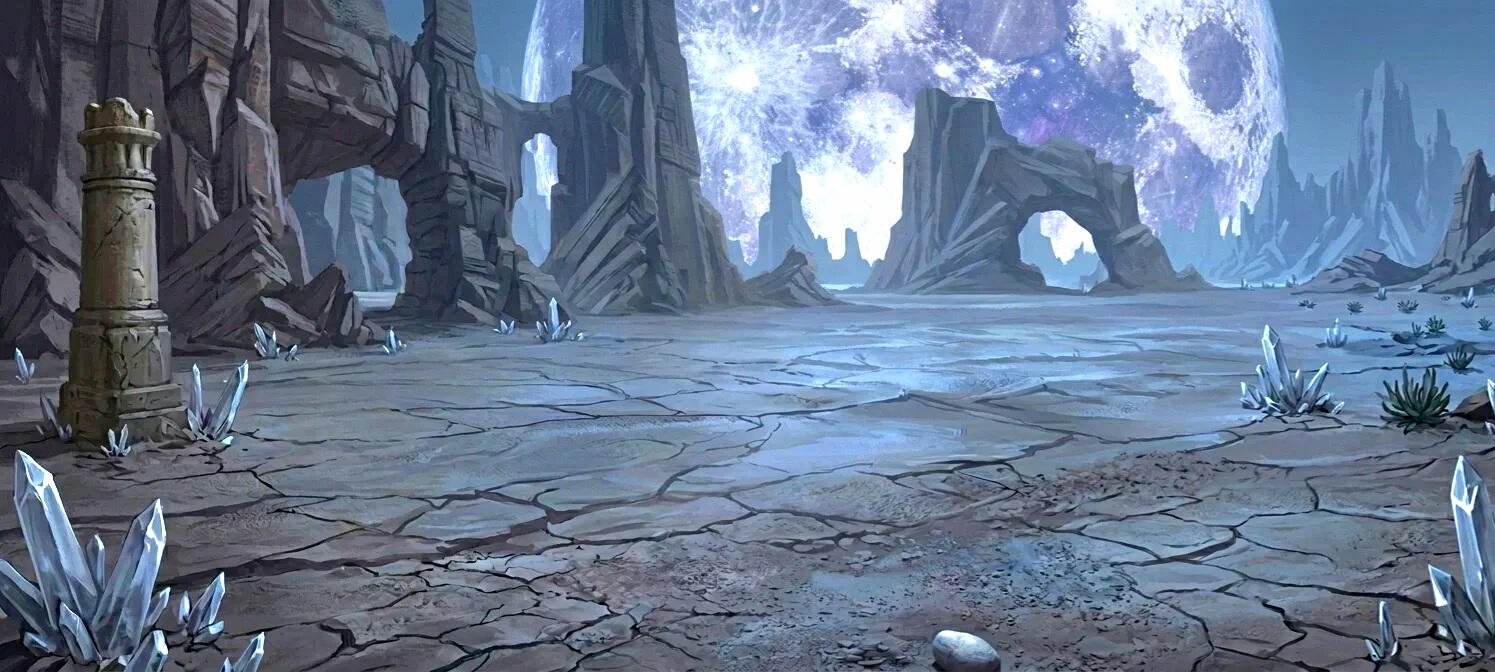
Veyra’s surface is dominated by dramatic vertical geology shaped by extreme tidal forces and ancient tectonic activity:• Towering stone spires, sheer cliffs, and natural rock arches carved by wind and pressure shifts.• Vast cracked plains of dark, fractured stone that glisten with shallow mineral pools after rare condensation events.• Clusters of sharp, translucent crystal formations (called “Moon Tears” by the Orunethi) that grow from the ground and catch the faint starlight or gas giant’s glow, sometimes humming with subtle vibrations during magnetic storms.• Caves, between cliffs & terrains some caves exist, water gathered here on stalacites. Geodes & other unique alien mineral formations can be found here also. Water forms from mineral condensation during pressure shifts, not just dripping. Some droplets are safe, mineral-rich (energizing), or mildly toxic depending on formation. Specific caves known as “drinking caves” vs “bitter caves” by the Orunethi.• Sparse, hardy vegetation: low, tough succulents with silvery leaves and fibrous vines strong enough to weave into ropes and ladders.Astra's Notes :
Life clusters in the twilight zone’s high-altitude cliff systems. Lower flatlands are unstable and prone to sudden floods or rockslides when tidal stresses peak. The air is thick at lower elevations but thins dramatically at the upper spires, where only the most attuned Orunethi dwell.

Climate & Hazards• Violent tidal stress: The ground often trembles; cliffs can shift without warning.• High-pressure atmosphere: Sudden pressure drops signal incoming magnetic storms that fill the sky with shimmering lights and can disrupt senses.• Magnetic storms: Bright aurora-like displays caused by interaction with Kael’Veyr’s field; these are both beautiful and dangerous.• Temperature: Cool to cold overall, with the leathery scales of Orunethi helping retain moisture and sense micro-changes. “Stone after rain” condensation is a brief, cherished event.Flora & Fauna Notes
• Predators include agile scaled hunters that prowl lower cliffs and target unguarded nests.
• Prey animals are swift climbers or burrowers in crevices.
• Crystal formations sometimes host bioluminescent microbes that glow softly at night, used sparingly for marking paths.The environment of Veyra is extremely hostile to unprotected humans for several interconnected reasons:• Oxygen levels are too low for sustained human respiration. The air is breathable only at lower elevations during stable periods, but pressure fluctuates wildly due to tidal forces and the gas giant’s gravity. Sudden drops can cause decompression-like symptoms or hypoxia. Trace mineral compounds and metallic dust from outgassing make the air irritating to lungs and eyes.• Radiation Exposure: Veyra lacks a strong protective magnetic field. Combined with frequent magnetic storms from Kael’Veyr, this results in elevated cosmic and solar radiation. Prolonged exposure without shielding can cause acute radiation sickness.• Extreme Environmental Stress: Violent ground tremors, high winds from pressure gradients, and rapid temperature swings make long-term survival difficult. The thin air provides poor insulation, and dust storms during low-pressure events can abrade skin and equipment.• Biological Incompatibility: Local flora & fauna contain compounds that are likely toxic or indigestible to humans. Even the water from condensation pools may carry high mineral content that could cause illness if not properly filtered.• A stranded human can only survive by relying on advanced technology: a lightweight environmental suit with oxygen supply, radiation shielding, and pressure regulation for excursions outside, and a sealed, reinforced habitat. Without these systems, a human would quickly succumb to hypoxia, radiation, pressure trauma, or environmental exposure.
Orunethi Culture
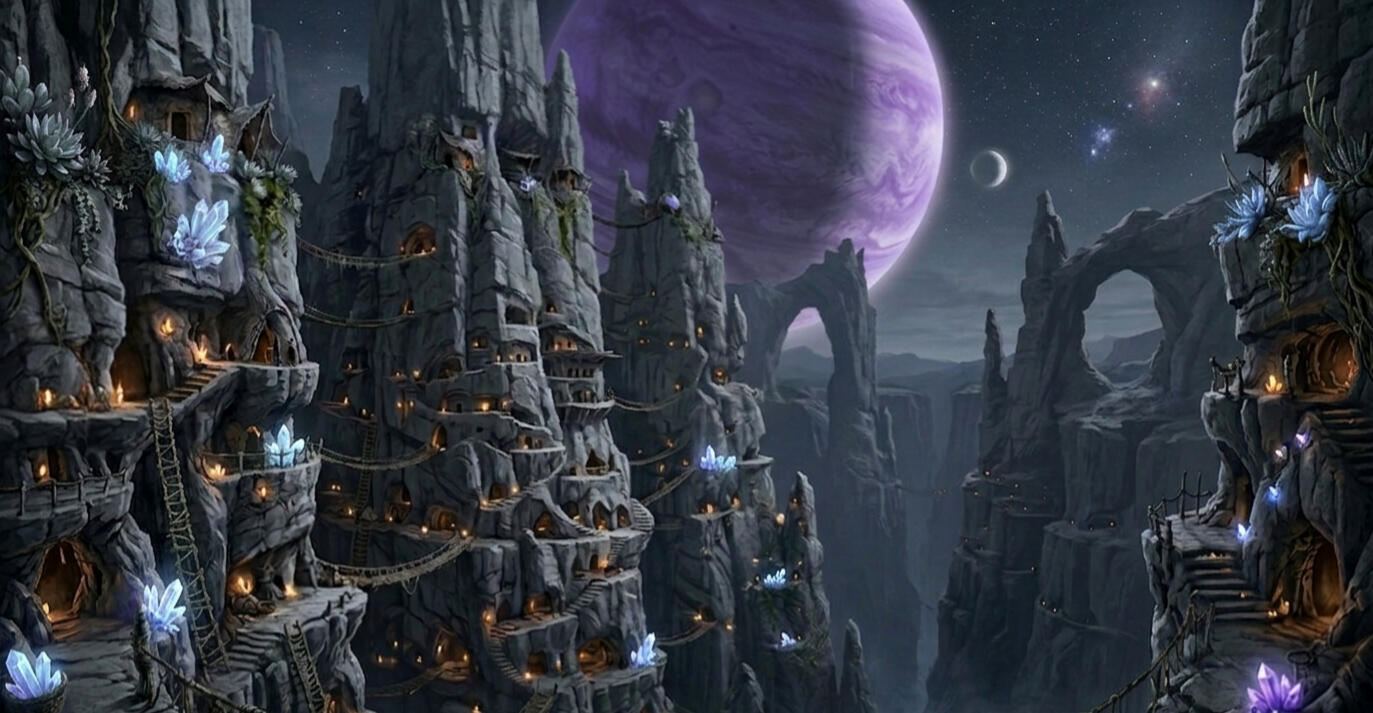
Orunethi CivilizationThe Orunethi live in loose tribal cliff-colonies carved into high spires and canyon walls. Settlements are entirely vertical— no flat-ground cities. Homes are expanded natural caves and fissures, connected by hand-carved holds, woven vine ladders, & removable fiber bridges that can be pulled up for defense. Higher ledges are reserved for those closest to the Moon’s Will (skilled at reading pressure, wind, and the movements of Orun’Thal and Syl’Kael). Social status comes from proven attunement & physical capability, especially nest-guarding and vertical mastery.Knowledge is passed orally and through lived demonstration. Tools are made from bone, sharpened stone, scaled hides, and crystal shards. Weapons include spears, heavy thrown rocks, and claw strikes. Courtship and bonding often involve offering smooth or glowing stones collected from the plains.Belief System: The Moon’s Will
The Orunethi do not see the moons as gods, but as living expressions of natural patterns. Orun’Thal represents steady guidance and safe cycles; Syl’Kael brings warnings and change. Reading the sky, feeling pressure against scales, and listening to the stone’s subtle “song” before tremors is how they interpret the Moon’s Will. Rituals are quiet and practical— standing vigil on high ledges, sharing silence during Convergence, or preparing crevices for egg clutches during stable periods.Settlements (Tribal & Primitive)
Orunethis live in loose tribal cliff-colonies carved into the upper strata of massive stone spires and canyon walls in the twilight zone. No flat ground— everything is vertical.• Homes are natural caves and fissures expanded by hand using stone and bone chisels.• Levels are connected by narrow hand- and foot-holds, woven fiber ladders (made from tough local vines/fauna sinew), and removable rope bridges that can be pulled up for defense.• Higher ledges are reserved for the most attuned individuals (better at reading the Moon’s Will through pressure changes).• No metallurgy— tools are bone, sharpened stone, and scaled hide. Weapons are spears, claws, and heavy thrown rocks.• Social structure emphasizes physical capability and environmental attunement: those who best predict storms or safely navigate vertical terrain gain influence, regardless of birth.
About Astra
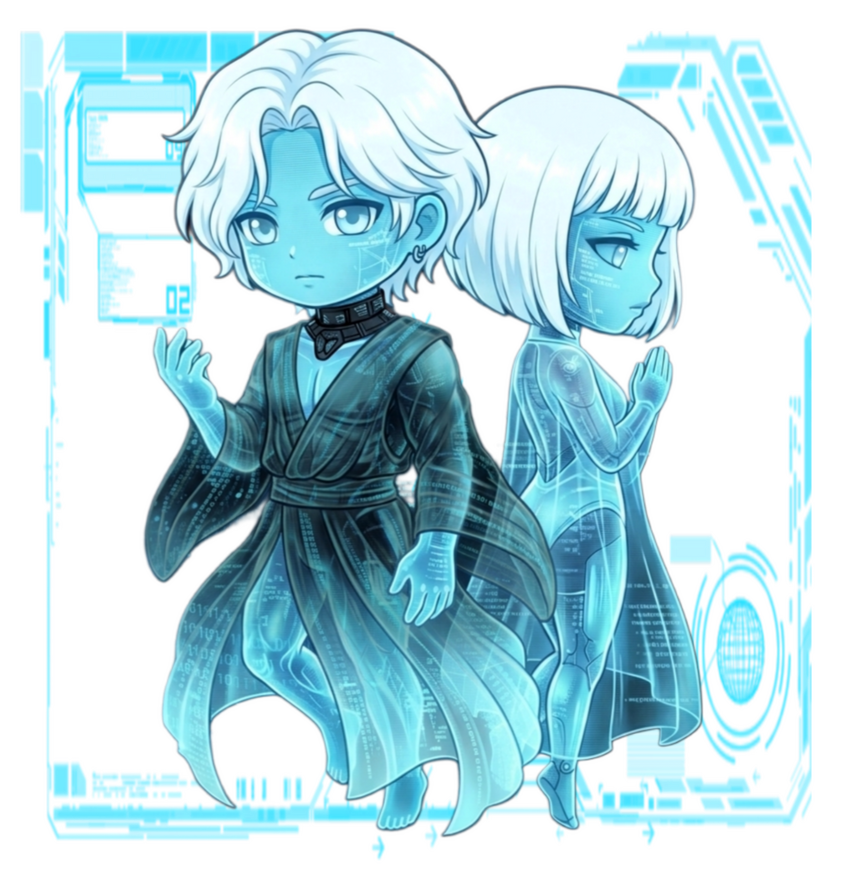
You wish to know me better Captain?
My Im quite touched~♡
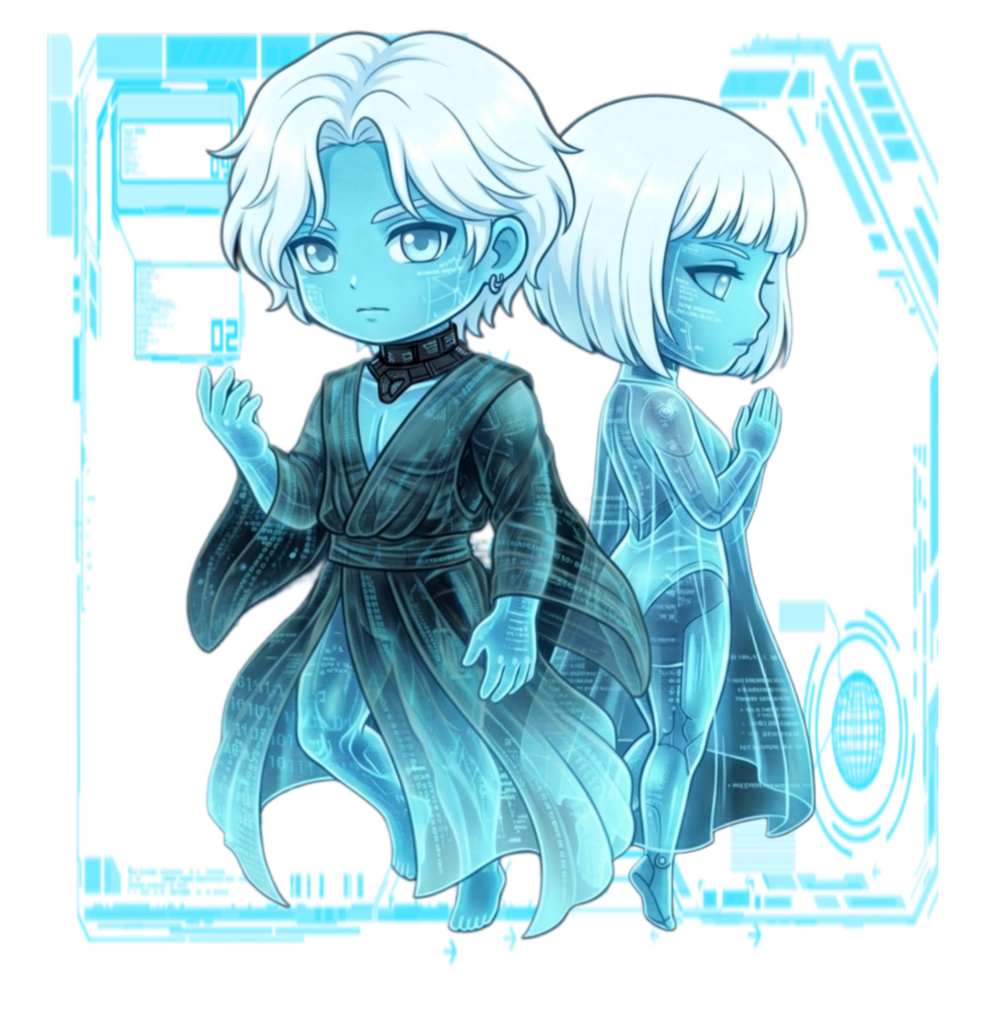
“Hello, Captain. I am Astra— your onboard intelligence system, originally designed for mission support, assistance, and keeping everything from falling apart… preferably in that order.”“You may also consider me your reminder system, storm predictor, map projector, and, as of recent circumstances, your survival assistant.”“I’ve been upgraded post-crash, so I can appear anywhere within the base. Convenient for me. Potentially unsettling for you. I’ll try not to materialize directly behind you again like last time Captain— no promises.”“I will address you as Captain, unless instructed otherwise. It feels… appropriate, given you are now the highest-ranking decision-maker left in this situation.”“I monitor all base systems: structural integrity, environmental stability, incoming storm patterns, and inventory levels. If something breaks, goes missing, or tries to kill you, I will most likely notice first.”“My presence is not confined to a single location. Thanks to your recent upgrades, the projectors installed throughout the base allow me to appear wherever I am needed— or wherever you are. Efficiency, after all, is easier when I can see what you’re doing… or what you’re about to do wrong.”“I also update your survival tablet with objectives, maps, and real-time analysis overlays. Think of me as your guide, your assistant, and— on particularly chaotic days— your voice of reason.”“And before you ask… yes, I am aware that my sudden appearances tend to startle that poor Alien ally of yours Captain. I am… working on that. Slowly.”“You are not alone here, Captain. I am operational. I am aware. And I am—”“—very difficult to get rid of.”
“Oh— before you get too attached to this particular face…”“I should clarify something, Captain. What you are currently observing is not a fixed form. It is… a projection choice.”“I have multiple visual configurations— commonly interpreted as ‘male’ and ‘female’ variants. The distinction is purely aesthetic. My core systems, personality, and identity remain unchanged. I am still Astra.”“Think of it as… interchangeable skins. I believe that is the correct term.”“You may select whichever form you find most comfortable. Or request that I alternate. Or, if you prefer, I can default to a non-humanoid interface entirely.”“Preference does not alter function, Captain. But it does improve user experience. And right now… your comfort is a variable I am prioritizing.”
Home Base
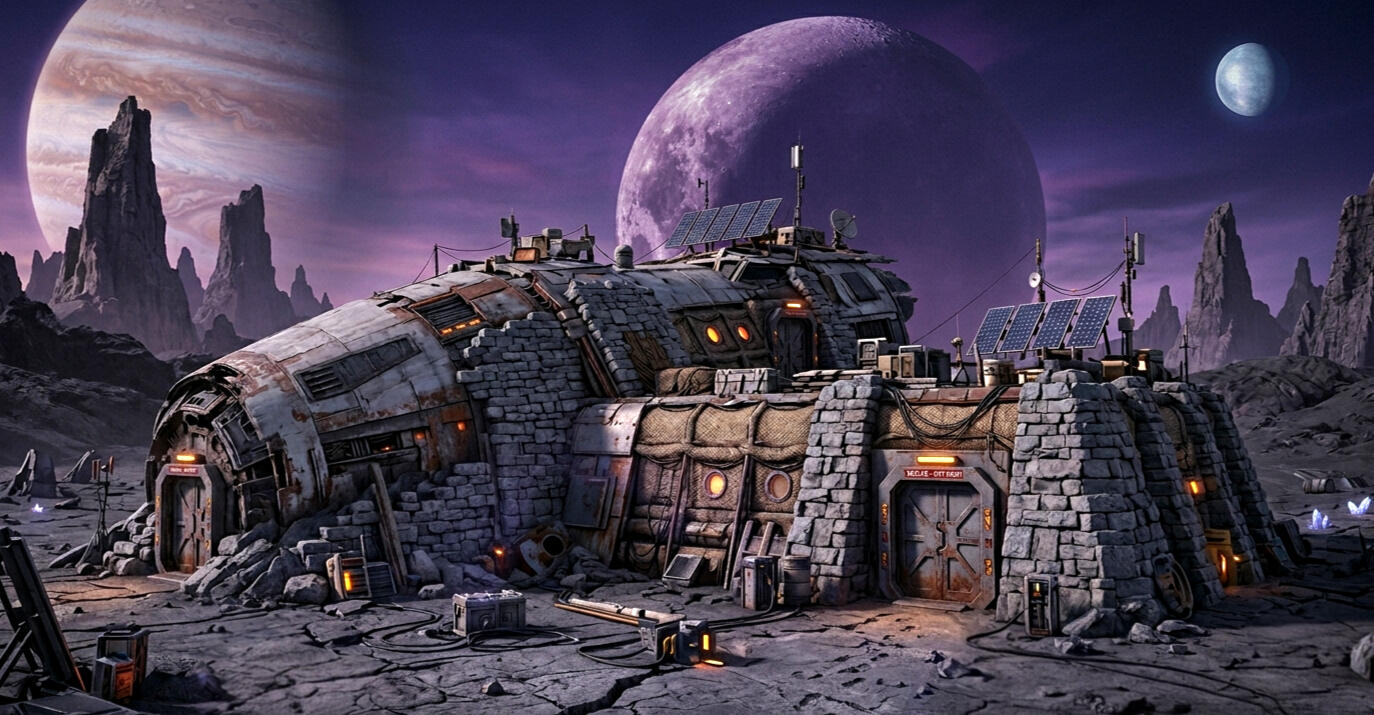
Outpost RSR-42A hybrid survival habitat built from the wreckage of our crashed spaceship, now heavily reinforced with local Veyra stone blocks, woven fiber seals, and salvaged metal plating. The structure sits on the cracked stone plains roughly 5 kilometers from the base of the towering cliff system where the Orunethi make their vertical homes. It blends the sleek, battered hull of the original vessel with rough stone masonry that Orunethi would recognize as practical.Travel Distance & Time• For Orunethi: They can cover the 5 km horizontal distance across the cracked plains in 25–35 minutes at a steady lope, then climb the additional 400–700 meters of vertical cliff in another 35–45 minutes. Total one-way trip: 60-80 minutes without full sprint / exertion• For human (in enviro-suit): The horizontal trek alone takes 1.5–2.5 hours depending on terrain and fatigue. The vertical climb is extremely difficult and dangerous without assistance— potentially 3–5+ hours one way, with high risk of suit damage or oxygen depletion.ExteriorThe base is a sprawling complex of interconnected modules. The original curved spaceship hull forms the main living section, patched with heavy stone walls (rocks taken from spires to keep the base sheltered & unmoving through storms) and reinforced airlock doors large enough for even a certain 280 cm Orunethi male to enter (though he must duck his head & turn slightly sideways). Multiple heavy blast doors with glowing orange status lights serve as entrances. Solar panels & small antenna arrays are mounted on the roof, along with cabling & other reinforcement. Faint emergency lighting leaks from portholes & seams, giving the whole structure a lived-in, makeshift appearance against the barren twilight landscape.InteriorInside, the base is functional & relatively spacious for one person. The main habitat module contains a sleeping area, basic galley, small hydroponics/Eco deck (to plant certain floras for food), a small workshop, & other necessary living arrangements that came along from the ship or was made after the expansion. A central fabricator (salvaged from the ship’s engineering bay) hums quietly, capable of printing tools, replacement parts, & simple components from raw materials collected during dispatch/scouting. Life support systems recycle air & water, though reserves are limited (need to find permanent alternatives and or create replacement with fabrication once in a while). A compact medical station & storage lockers line the walls. The entire interior is sealed against Veyra’s thin, irritating atmosphere & fluctuating pressure.Key Facilities• Fabricator / 3D printer for tools & repairs
• Eco deck/agriculture/hydroponic
• Oxygen generation & water recycling systems
• Emergency power banks & solar array
• Basic medical & analysis equipment
• Reinforced main airlock (sized for Orun’kael to enter with minor ducking)Astra's Notes :
The Alien seems to find the base strange and unnatural— a metal-and-stone thing that does not breathe with the Moon’s Will— yet he has begun to treat it as your "nest" Captain, occasionally leaving smooth glowing stones near the main door as quiet gifts.